Sewer Camera Inspection
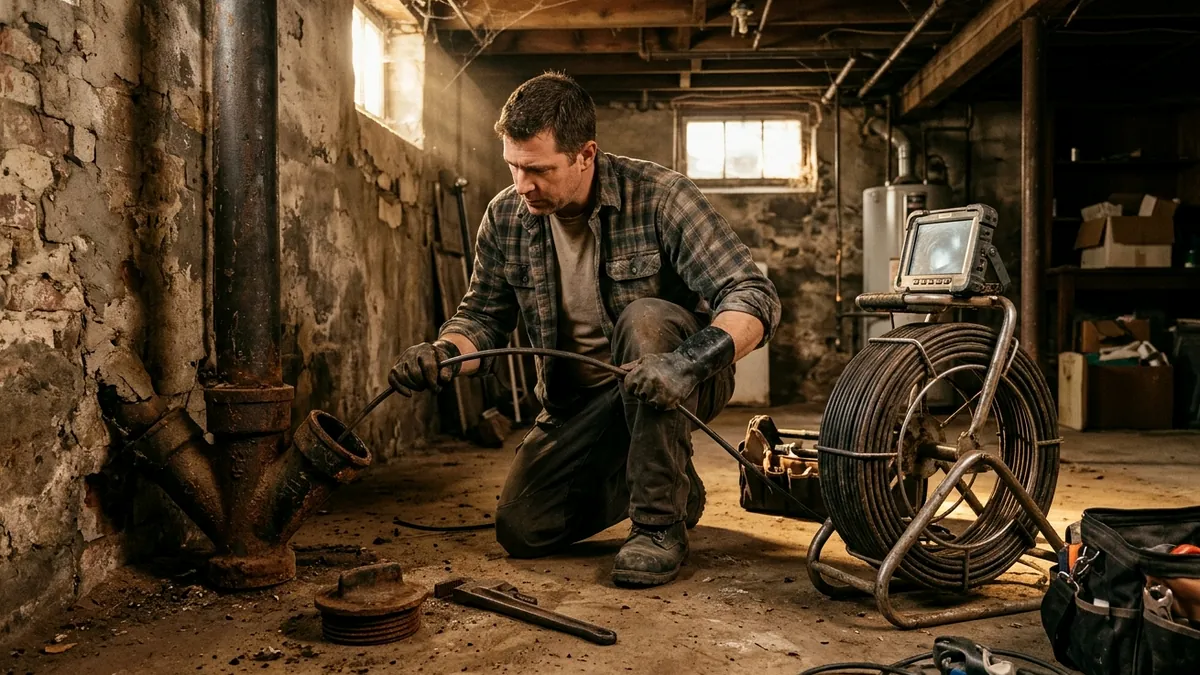
The main keeps clogging and nobody can tell you why, or you are about to buy an older house and want to know what is under the floor. A camera answers that...
Learn moreDrains & sewer
The camera found a break, a root mass or a section of pipe that has collapsed. Cleaning will not fix it anymore, and the line needs a real repair before the next backup.
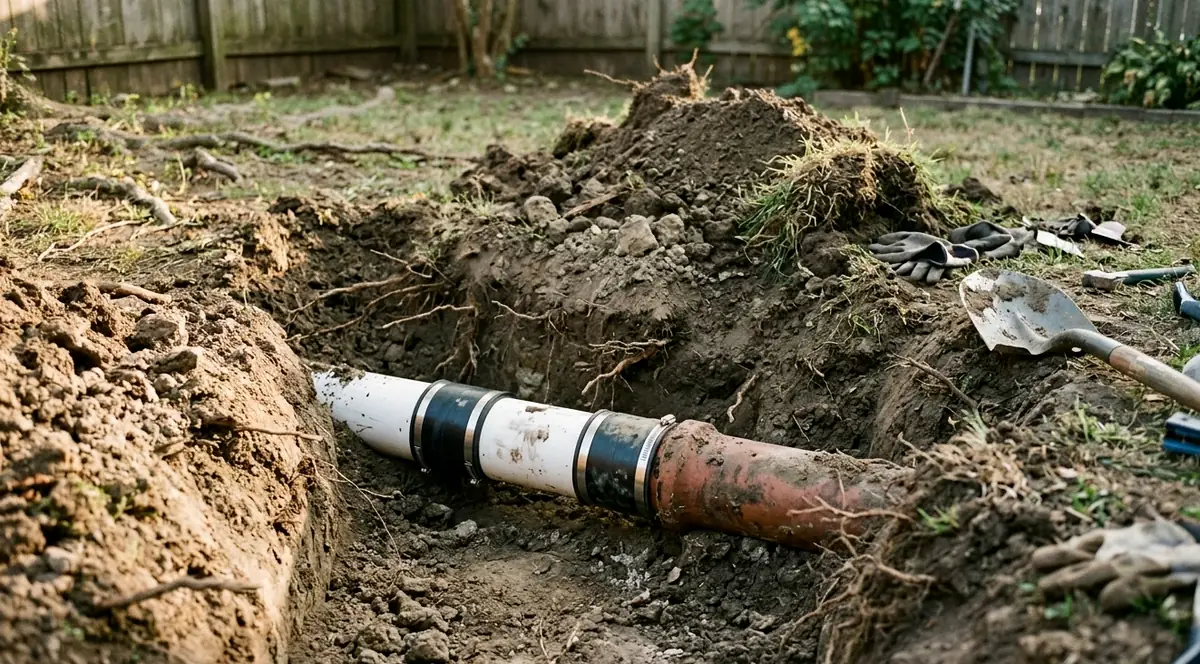
Sewer line repair fixes a damaged section of the building sewer or lateral, usually by excavating and replacing the bad pipe with PVC, or by lining or bursting where digging is hard. Typical Hartford-area spot repairs run about $1,845 to $5,965. We answer 24/7, camera-locate the damage first, and schedule once utilities are marked.
Vitrified clay pipe was used for laterals for decades. It resists corrosion, but its joints were often mortar or early gaskets that crack and let roots in. Once roots enter, they fill the pipe and can split it. Cast iron under basement floors and close to the house corrodes from the inside and can lose its bottom, leaving the soil to hold the water.
Other failures come from settling. A section can sag into a belly where waste sits and clogs. Joints can separate or offset, catching paper and grease. In some homes from the mid-twentieth century, the lateral is Orangeburg, a tar-impregnated fiber pipe that deforms and blisters with age. Each failure type points toward a different repair.
When the camera shows one bad section on an otherwise sound pipe, a spot repair makes sense. We locate the defect from above, call 811 to have utilities marked, excavate to the pipe and replace the damaged section with PVC sewer pipe joined to the old material with shielded transition couplings. The new section gets bedded in stone so it does not settle.
If the camera shows several breaks, a long belly or a line made of Orangeburg, patching one spot just moves the next failure down the pipe. In those cases, replacing the full run from the house to the connection, either by trench or trenchless methods, usually costs less over time. We give you both options and explain what each one leaves in the ground.
Many sewer problems sit under the basement slab, where cast iron runs from the stack to the foundation wall. To repair it, we saw-cut the concrete, break out a trench along the pipe, replace the bad section, and pour new concrete once it is tested. We contain dust with plastic sheeting and use water on the saw.
While the floor is open, it is a good time to add a cleanout if the house does not have a usable one, and to consider a backwater valve if the house is prone to sewer backups. Adding these now costs much less than opening the floor again later. We test the repair with water before backfilling and patching.
Many Hartford streets are lined with older homes whose laterals are clay out to the street, with maples and oaks planted right over them, so root-damaged joints are a common repair. Older multi-family houses often have long cast-iron runs under basement floors that have thinned with age. Where the public sewer is the older combined system, a broken house lateral makes rain-related backups more likely. We repair sewer lines in Hartford, West Hartford, Wethersfield, Newington and other nearby towns.
Depth, length of the bad section, what sits on top of it, and whether the repair is under a slab change the price. Typical Hartford-area range, confirmed on site before work starts. Compare all prices.
Process
We record the line, find each defect and mark its position and depth above ground.
We explain whether a spot repair, lining or full replacement fits, with a price for each option.
After utilities are marked, we open the ground or slab, replace the damaged pipe and bed it properly.
We camera the repaired section, backfill in compacted layers, and patch concrete or level the soil.
FAQ
A typical spot repair takes one to two days of work once utilities are marked, which usually takes a few business days. Under-slab repairs often take two days including concrete. Longer replacements can take several days. Your drains will be out of service while the line is open, and we plan the work to keep that time as short as possible.
Sometimes. If the existing pipe is round enough and not collapsed, it can be lined from the inside, or a new pipe can be pulled through it with trenchless methods. Small spot defects may be fixed with a sectional liner. A fully collapsed pipe or a deep belly usually needs excavation at that spot.
Standard policies often exclude wear, corrosion and root damage to the sewer lateral. Some carriers and utilities offer optional service line coverage, and some policies have a sewer backup endorsement for damage inside the home. Check with your agent. We provide video and a written description of the damage for any claim.
Related work
The main keeps clogging and nobody can tell you why, or you are about to buy an older house and want to know what is under the floor. A camera answers that...
Learn moreYour sewer lateral needs to be replaced, but it runs under the driveway, a mature tree or a front walk you do not want torn out. Trenchless methods can replace...
Learn moreEvery time a big storm hits, water comes up through the basement floor drain even though your own pipes are clear. The public sewer is surging back into the...
Learn moreA plumber answers, day or night, and gives you a price before any work starts.