Well Pressure Tank Replacement
A pressure tank that has lost its air cushion makes your well pump start every time you open a faucet. That wears the pump out, and replacing the tank is far...
Learn moreBasement, well & water
When the taps go dry on a house with a private well, the cause is usually the pump, the pressure switch or the controls. We track it down and get water flowing again.
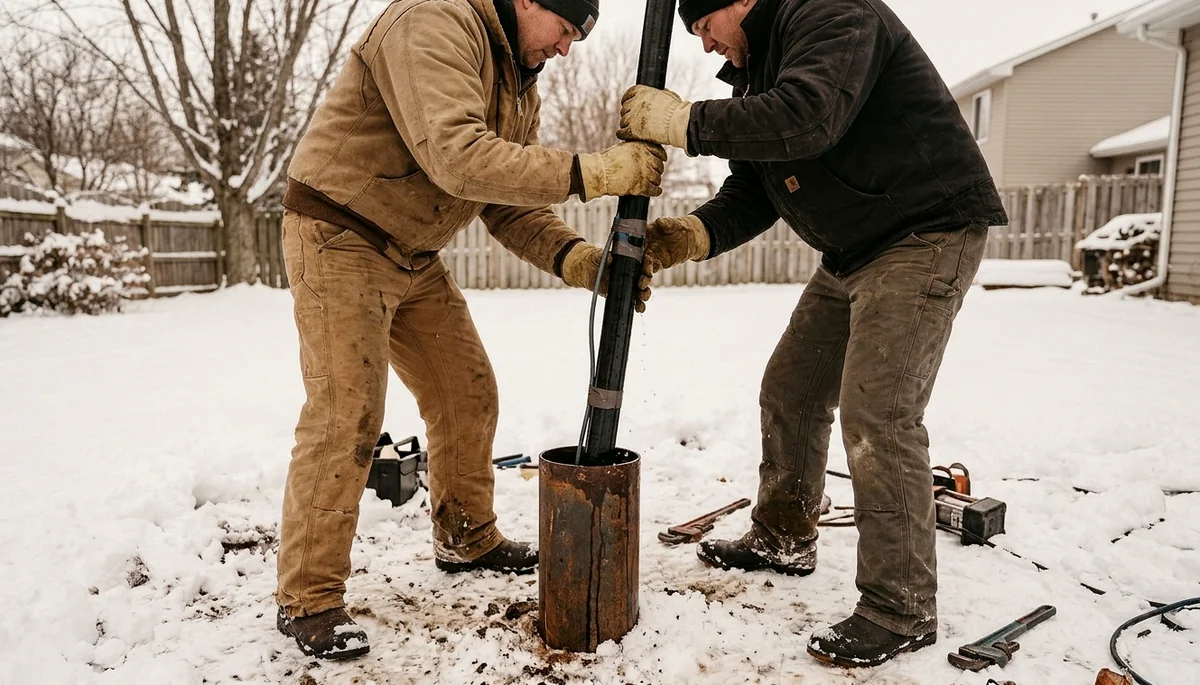
Well pump repair diagnoses why a submersible or jet pump has stopped delivering water and fixes the switch, control box, wiring or pump itself, including pulling a submersible from the well when needed. Typical costs in the Hartford area run about $245 to $3,460. We answer 24/7, come out fast when you have no water, and quote the price before work starts.
Before anyone pulls a pump, we check power. Most well pumps run on a dedicated 240-volt breaker, and a tripped breaker or a blown fuse in an older panel is common after a storm. Next is the pressure switch, the small gray box on the pipe near the pressure tank. Its contacts burn and pit over years, and a stuck switch will not tell the pump to start.
A clogged pressure switch tube, a dead capacitor in a three-wire control box, or a loose wire at the well cap can all stop a pump that is otherwise fine. We test voltage and amperage at the switch and control box to see whether the pump is drawing power. These readings tell us whether the problem is up top or down the well.
Most wells in Vernon, Ellington, Tolland and Coventry are drilled wells with a submersible pump hanging on pipe several hundred feet down. When the motor fails, the wiring splice breaks or the pump wears out, it has to be pulled out of the well with the pipe and wire. We use proper pulling equipment and inspect the drop pipe and wire for damage on the way up.
Some older homes have shallow dug wells or jet pumps in the basement that pull water up by suction. Jet pumps lose prime when a foot valve leaks or the suction line draws air, and their impellers and seals wear. They are easier to reach than submersibles, so repairs usually cost less, and we can often rebuild rather than replace.
A pump that turns on and off every few seconds while you run water is short cycling, and it burns up motors quickly. The usual cause is a waterlogged pressure tank, which no longer holds a cushion of air, or a pressure switch set wrong. Fixing the tank often saves the pump. A leaking check valve can also let the system bleed down overnight.
Sand and sediment wear the impellers inside a submersible pump, and a well that runs low in late summer can let the pump run dry, which overheats it. If your pump has failed more than once, we look at why: tank, check valve, water level or pump size. A cycle stop valve or a constant pressure system may help in some homes.

Many homes east of the Connecticut River, in Vernon, Ellington, Tolland, Coventry, Bolton and parts of Glastonbury and South Windsor, are on private wells. When power fails after a storm, the well pump stops too, so outages and pump problems often show up together. Old wiring splices, aging pressure switches and waterlogged tanks are the most common fixes we make in these towns.
A pressure switch or capacitor is a small repair; pulling a deep submersible and replacing the pump, wire and pipe costs the most. Typical Hartford-area range, confirmed on site before work starts. Compare all prices.
Process
Call (860) 926-8723 and tell us what the faucets and pressure gauge are doing.
We check the breaker, pressure switch, control box, tank and pump amp draw.
We replace the failed part, or pull and replace the pump, quoting the price before work starts.
We restore pressure, run water until it clears, check the tank and clean up.
FAQ
Power surges and outages can trip the pump breaker, burn pressure switch contacts or damage a control box capacitor. Sometimes the pump loses prime on a jet system. Check the breaker first. If the breaker is on and there is still no water, call us; we test the switch, control box and pump to find the fault.
A pressure switch, control box or wiring repair often takes one to two hours. Pulling and replacing a submersible pump usually takes most of a day, depending on well depth and the condition of the pipe and wire. We give you an estimated timeline when we diagnose the problem.
Yes. Every start puts stress on the motor, and a pump that turns on and off every few seconds wears out much faster. The usual cause is a waterlogged pressure tank or a pressure switch problem. Fixing the tank or switch promptly can save you the cost of replacing the pump.
Related work
A pressure tank that has lost its air cushion makes your well pump start every time you open a faucet. That wears the pump out, and replacing the tank is far...
Learn moreOrange stains in the tub, a rotten-egg smell in the shower or white crust on every faucet tell you something is in your well water. Treatment starts with...
Learn moreA shower that trickles, a faucet that sputters or pipes that bang when a valve closes all point to a pressure problem. The fix depends on finding where the...
Learn moreA plumber answers, day or night, and gives you a price before any work starts.