Start with what you have now
Before comparing models, look at what already heats your water and what fuel the house uses. A gas tank with a flue into the chimney, an electric tank, an oil or gas boiler that also heats water, or a coil inside the boiler itself all point to different upgrade paths. Changing fuel or venting adds cost, so the cheapest good choice is often the one that fits the gas line, chimney and electrical service you already have.
Then think about demand. Count the people in the house, the number of showers that may run at the same time, and any large soaking tub. In a two- or three-family house, check whether each unit has its own heater or whether one heater serves several apartments, because that changes the size you need. Note the age of the current heater too, since one near the end of its life is best replaced on a schedule rather than after it leaks.
Tank water heaters
A standard tank heater keeps 40 to 80 gallons hot and ready, and it is the simplest swap in most basements. Gas tanks heat back up faster than electric ones, so a 40 or 50 gallon gas tank often serves a family that would need a larger electric tank. Tanks are the lowest upfront cost and the easiest to service, and nearly any plumber carries the parts.
The tradeoffs are standby loss, the heat a tank gives off while it sits, and a limited supply during long back-to-back showers. Atmospheric gas tanks also depend on a sound chimney liner, and an old unlined masonry chimney may need attention when the heater is replaced. Typical Hartford-area costs to replace a standard tank run about $1,385 to $2,940 depending on size, fuel and venting, quoted on site before work starts.
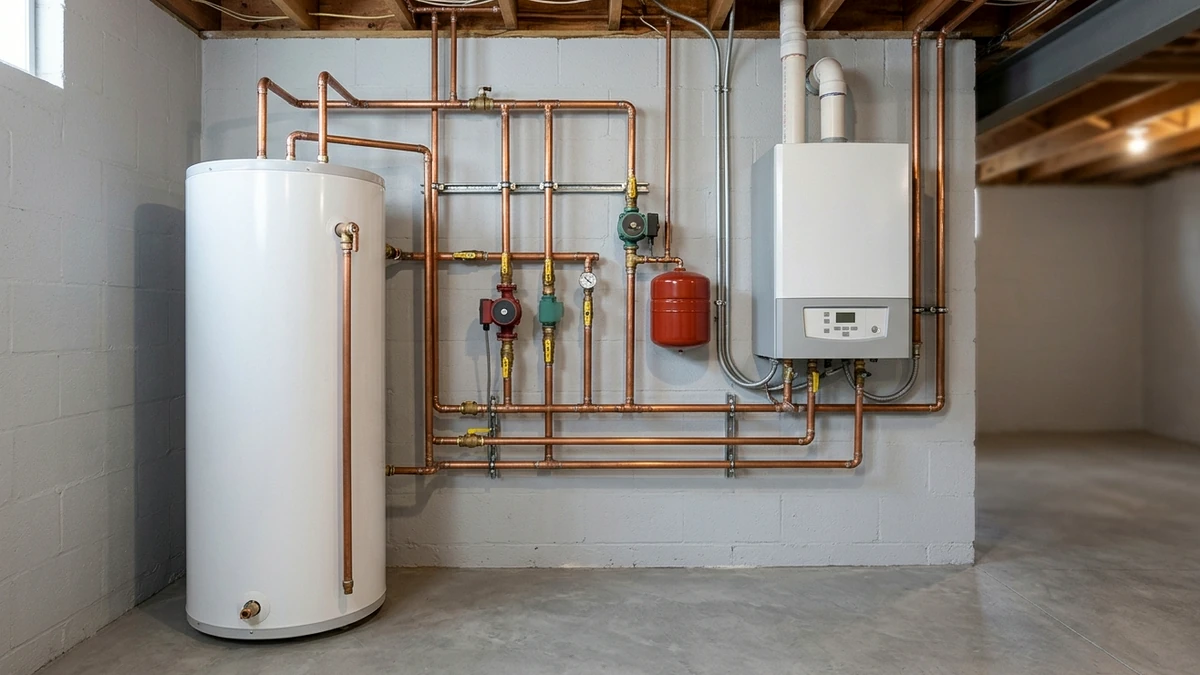
Tankless water heaters
A gas tankless heater fires only when a hot tap opens and heats water as it passes through, so it never runs out during a long run of showers and has no standby loss. It hangs on a wall, which frees floor space in a tight basement. Condensing models vent through PVC out a side wall, so they do not need the chimney at all.
Tankless units need a larger gas supply than most tank heaters, and an older home's gas line often has to be upsized. Winter matters in Connecticut: incoming water is colder in January, so the heater has to raise it more, and a unit sized only for summer can fall short when two showers run at once. Tankless heaters also need periodic flushing to clear scale. MDC water in Hartford is soft, which helps, but hard well water east of the river calls for flushing more often.
- Endless hot water, sized for winter inlet temperature
- Often needs a larger gas line
- Side-wall PVC venting on condensing models
- Needs flushing on a regular schedule
Indirect water heaters
If the house has a boiler, an indirect water heater is often the best match. It is an insulated storage tank with a coil inside, and hot water from the boiler runs through that coil to heat the domestic water. There is no separate burner or flue, the tank itself loses little heat, and a well-insulated indirect holds temperature for a long time. It works with gas and oil boilers alike.
The boiler has to run to make hot water, including in summer, so an indirect makes the most sense when the boiler is reasonably modern and efficient. Pairing one with an old oversized boiler can work against you in warm months. Many Hartford-area homes with hot-water heating take this route when the boiler is replaced, since the two are designed and piped together, with the boiler set to give hot water priority.
Heat pump water heaters
A heat pump water heater looks like a tall electric tank with a unit on top. Instead of heating water with an element, it pulls heat from the surrounding air and moves it into the tank, which uses far less electricity than a standard electric heater. It also cools and dries the air around it as a side effect, which many owners like in a damp basement in summer.
It needs room. The unit needs a fair amount of open air around it to work well, so check the maker's space requirement, a condensate drain, and a basement that stays above the manufacturer's minimum temperature in winter. It is louder than a tank, about like a dehumidifier, and recovers more slowly unless it switches to its backup element. Check current Energize CT offers before you buy, since efficiency rebates come and go.
- Uses much less electricity than a standard electric tank
- Needs open air space and a condensate drain
- Cools and dehumidifies the room
- Check current Energize CT offers first
Making the choice
As a rough guide: if you have a working boiler, look first at an indirect. If you have gas and want endless hot water, compare a high-efficiency tank with a condensing tankless. If you are all-electric with a roomy basement, a heat pump water heater usually costs the least to run. If you want the lowest upfront cost and simplest service, a standard tank remains a fair choice.
Whatever you pick, the install should include a properly piped temperature and pressure relief valve with a discharge line toward the floor, a thermal expansion tank where the system needs one, and a mixing valve or a setting near 120 degrees to limit scalding. Call (860) 926-8723 to talk through your house. We look at the gas line, venting and space, then quote the price before work starts.
Key takeaways
- Start from your existing fuel, venting and boiler
- Size tankless units for January water temperatures
- An indirect is often best with a modern boiler
- Heat pump models need open air space and a drain