How a well system works
Towns east of the Connecticut River, including Vernon, Ellington, Tolland, Coventry, Bolton and parts of Glastonbury and South Windsor, have many homes on private wells. In most of them a submersible pump sits deep in a drilled well and pushes water up a pipe, through the ground and into the basement. Some older or shallower wells use a jet pump that sits in the basement and pulls water up instead.
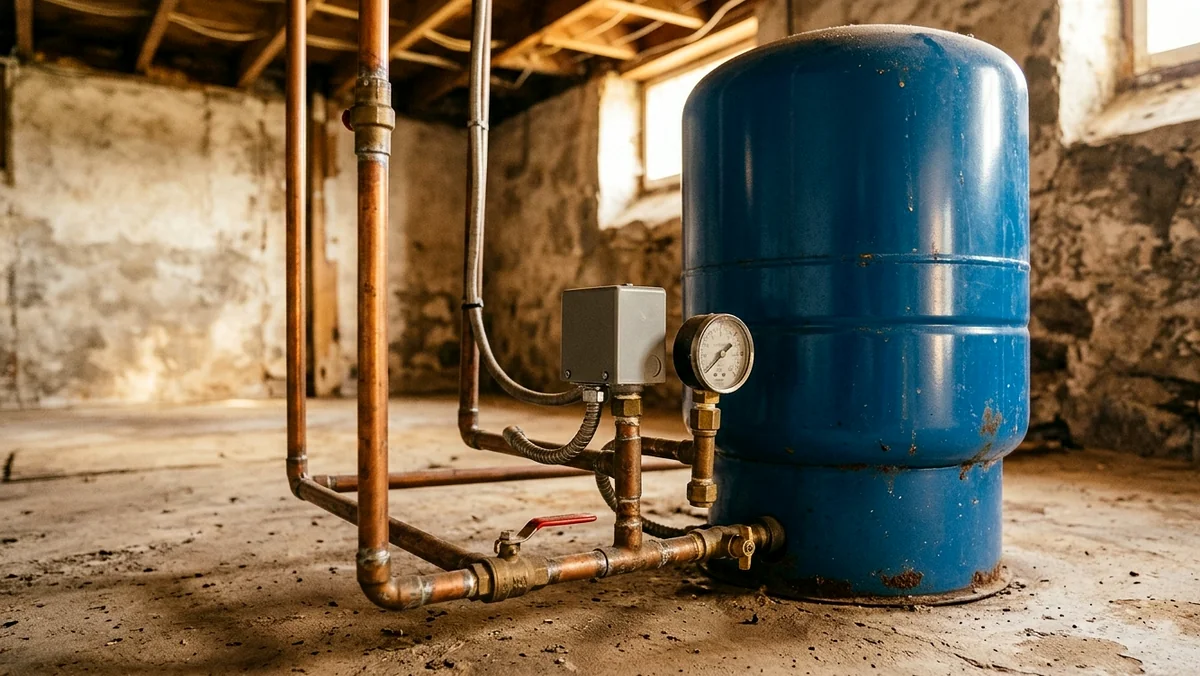
The pump does not run every time you open a faucet. It fills a pressure tank, a steel tank with an air chamber and a rubber bladder or diaphragm inside. As water enters, it squeezes the air, and that compressed air pushes water out to your fixtures. A pressure switch near the tank turns the pump on when pressure drops to a set point and off when it reaches the upper setting.
Parts you can see in the basement
Near where the well pipe enters, you will usually find the pressure tank, a fitting called a tank tee with a pressure gauge, the pressure switch in a small gray box, a drain valve, and a relief valve. Many homes also have a sediment filter and water treatment equipment after the tank. Learning what each part looks like makes it easier to describe a problem over the phone.
The gauge is the most useful thing in the basement. Watch it while someone runs a faucet: the needle should fall steadily, the pump should kick on at the lower setting, and the needle should climb back to the upper setting before the pump shuts off. Common switch settings are 30 to 50 psi or 40 to 60 psi. Write yours down when the system is working well so you have something to compare against.
- Pressure tank
- Pressure gauge on the tank tee
- Pressure switch (gray box with wires)
- Relief and drain valves
- Filters and treatment equipment
Signs something is wrong
Short cycling is the most common warning. If you hear the pump click on and off every few seconds while a faucet runs, or the gauge needle swings up and down quickly, the pressure tank has likely lost its air charge or its bladder has failed. Short cycling wears out the pump and switch, so it is worth fixing quickly rather than living with it.
Other signs include sputtering faucets with air in the water, pressure that fades during a shower, the pump running without shutting off, no water at all, or water that suddenly turns cloudy or sandy. A pump that runs constantly may be pumping into a leak, a broken pipe between the well and the house, or a well that is drawing down faster than it refills, which can happen in a dry late summer.
- Pump clicking on and off rapidly
- Pressure fading during use
- Air spitting from faucets
- Pump that never shuts off
- Cloudy or sandy water
Safe checks you can do
Start with the breaker. Well pumps run on a dedicated 240-volt circuit, and a tripped breaker is a frequent cause of no water. Reset it once. If it trips again, leave it off and call, because repeated tripping points to a pump, wire or switch problem. Do not open the pressure switch cover with the power on, since the contacts inside carry live current.
To check the tank's air charge, turn off the pump breaker, open a faucet to drain the tank to zero pressure, then check the air valve on top of the tank with a tire gauge. The reading should be about 2 psi below the pump's cut-in setting, so about 28 psi for a 30 to 50 switch. If water comes out of the air valve, the bladder has failed and the tank needs replacing.
Repair or replace
A pressure switch with burned contacts, a failed gauge or a waterlogged tank are fairly quick fixes in the basement. A submersible pump that has failed means pulling the pump, pipe and wire up out of the well, which takes equipment and care. Typical Hartford-area ranges run about $785 to $1,690 for a pressure tank replacement and $1,890 to $4,370 for a submersible pump replacement, depending on depth and pump size. The final price is quoted on site before work starts.
Sometimes the right answer is both. An older pump that has been short cycling for months against a failed tank may be close to the end, and replacing only one part can lead to a second visit. A plumber will check the current draw on the pump, the tank, the switch and the wiring before recommending anything, so you know which parts are actually failing.
Keep the well water safe
A private well is the owner's responsibility, which includes the water quality. A common recommendation is to test for bacteria at least once a year and to run a broader test every few years, or any time the taste, smell or color changes, or after flooding or work on the well. Connecticut wells can contain naturally occurring minerals and other substances, so a full panel from a state-approved lab is worth doing.
Keep the well cap sealed and a few inches above the ground, keep fertilizer, fuel and pet waste away from it, and call 811 before digging anywhere near the well line. If the water test shows a problem, treatment such as a filter, softener or UV system can be chosen to fit the result. For pump trouble or no water, call (860) 926-8723. We answer 24/7, every day of the year.
Key takeaways
- The pressure tank stores water so the pump does not run constantly
- Rapid clicking usually means a lost air charge or failed bladder
- Set the tank air charge 2 psi below cut-in with the pump off
- Test well water for bacteria at least yearly