Where the main shut-off usually is
In most Hartford-area homes on city water, the service pipe enters through the basement wall that faces the street, and the main shut-off is right there, just inside the foundation. The water meter sits on the same pipe, often with a valve on each side. The valve on the street side of the meter is the main shut-off for the house. In houses with no basement, look in a utility closet, under the kitchen sink or near the water heater.
In a two- or three-family house, there is usually one main valve for the whole building in the basement, and sometimes separate valves for each apartment or each riser. Follow the pipe from the meter and see where it branches. Homes on a private well do not have a meter. The main valve sits near the pressure tank, and switching off the pump breaker also stops the flow.
- Basement wall facing the street
- Beside the water meter
- Utility closet or near the water heater if there is no basement
- Near the pressure tank on well homes
Gate valves and ball valves
Older homes often have a gate valve, with a round wheel handle you turn several times to close. Inside, a wedge slides down across the pipe. Gate valves that sit untouched for years tend to seize, and when they are finally turned, the stem can strip or the wedge can stick partway, so the water keeps running. Some also start leaking at the stem once they are moved after a long rest.
Newer installations use a ball valve, with a lever handle that turns a quarter turn. When the lever lines up with the pipe, the valve is open. When it sits across the pipe, the valve is closed. Ball valves close fully, rarely seize, and are easy for anyone in the house to operate in an emergency. Many plumbers recommend replacing an old gate valve main with a full-port ball valve.
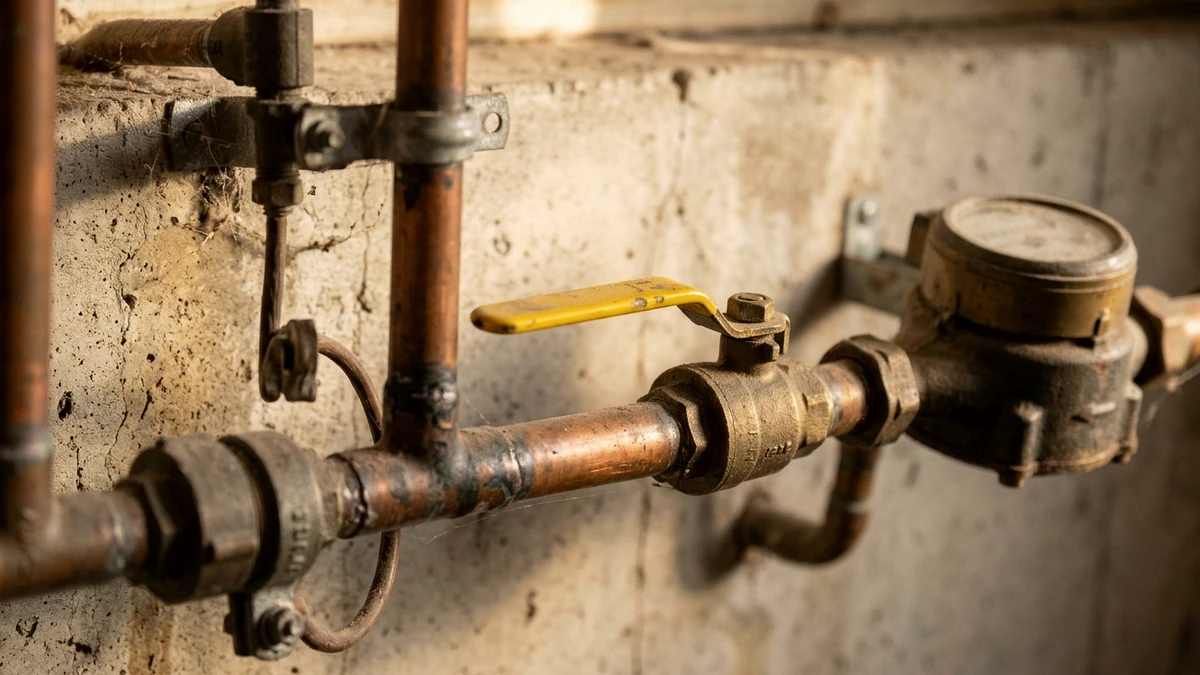
How to test the valve
Pick a time when nobody needs water, and have a bucket and a rag nearby. Turn the valve slowly and gently toward closed. A gate valve may take several full turns, and a ball valve takes a quarter turn. If it feels stiff, stop and do not force it. A valve that will not turn with normal hand pressure needs a plumber, not a pipe wrench or a cheater bar.
Once it is closed, open a faucet on the first floor. The flow should stop within a few seconds, with maybe a trickle as the pipe drains. If water keeps running steadily, the valve is not sealing. Then open the valve slowly, close the faucet, and check the valve stem for drips. A small drip at a gate valve stem can sometimes be stopped by snugging the packing nut a little.
- Turn slowly, never force it
- Open a faucet to confirm the water stops
- Reopen slowly to avoid a pressure surge
- Check the stem for drips afterward
The valve at the curb is not yours to turn
There is often a second valve, called a curb stop, under a small metal cover in the sidewalk or front yard. It belongs to the water utility. For Hartford and the MDC member towns, that is the Metropolitan District. Homeowners should not try to operate it, since it takes a special key and a damaged curb stop is a bigger problem than the one you started with.
If your own main valve fails during an emergency and you cannot stop the water, call the water utility to shut the curb stop, and call a plumber at the same time. Having the utility's emergency number written next to the main valve, along with ours at (860) 926-8723, saves time on a bad night. We answer 24/7, every day of the year.
Make the valve easy to use
Once you know the valve works, make it easy for anyone to find. Clear boxes and shelves away from it, hang a bright tag on the handle, and show everyone in the house, including tenants and anyone who checks on the place while you travel. Note which smaller valves control the water heater, the outdoor faucets and each apartment, and label them too. A simple sketch taped near the panel helps.
Test the main valve about once a year by closing and reopening it. Regular use keeps a gate valve from seizing and tells you early if it has started to fail. If the valve does not shut the water off completely, leaks at the stem, or will not turn, replace it before an emergency. Typical Hartford-area costs to replace a main shut-off run about $285 to $640, quoted on site before work starts.
Key takeaways
- The main valve is usually on the street-side basement wall near the meter
- Never force a stiff valve
- The curb stop belongs to the water utility
- Test the main once a year and replace it if it will not seal