What a cleanout is and what it does
A cleanout is a fitting on your drain or sewer line with a removable plug or cap. When the main line clogs, a plumber opens it and feeds a cable, a jetter hose or a camera straight into the pipe. Without a cleanout, the only ways in are through a toilet, a sink trap or the roof vent, and none of those lines up well with the house sewer that runs under the yard to the street.
Every house that has a main line clog, a root problem or a camera inspection benefits from a cleanout that can be reached. It shortens the job, keeps sewage off your floors, and lets the equipment reach the problem without forcing it through bends it was never meant to pass. In older houses with fragile cast-iron or clay sewer pipe, a straight entry point also lowers the chance of damaging the line while it is being cleaned.
Why so many older houses lack a usable one
Many houses built before modern codes had only one cleanout, often a brass or iron plug at the base of the cast-iron stack. After decades of rust and old pipe joint compound, those plugs fuse to the fitting. Others were covered up when a basement was finished, buried when a new concrete floor was poured over the old one, or boxed in behind shelving that nobody wants to move during a backup.
Some older homes never had a proper cleanout at all, and the house sewer was simply run straight from the stack to the street. In Hartford-area two- and three-family houses and older single-family homes, it is common to find a cleanout that exists on paper but cannot be opened, or one that faces up the stack instead of toward the street, which is where the clogs and roots usually are.
- Plug rusted solid at the base of the stack
- Cleanout hidden behind a finished wall or under a floor
- Cleanout pointing the wrong direction for the street line
- No cleanout installed anywhere on the main drain
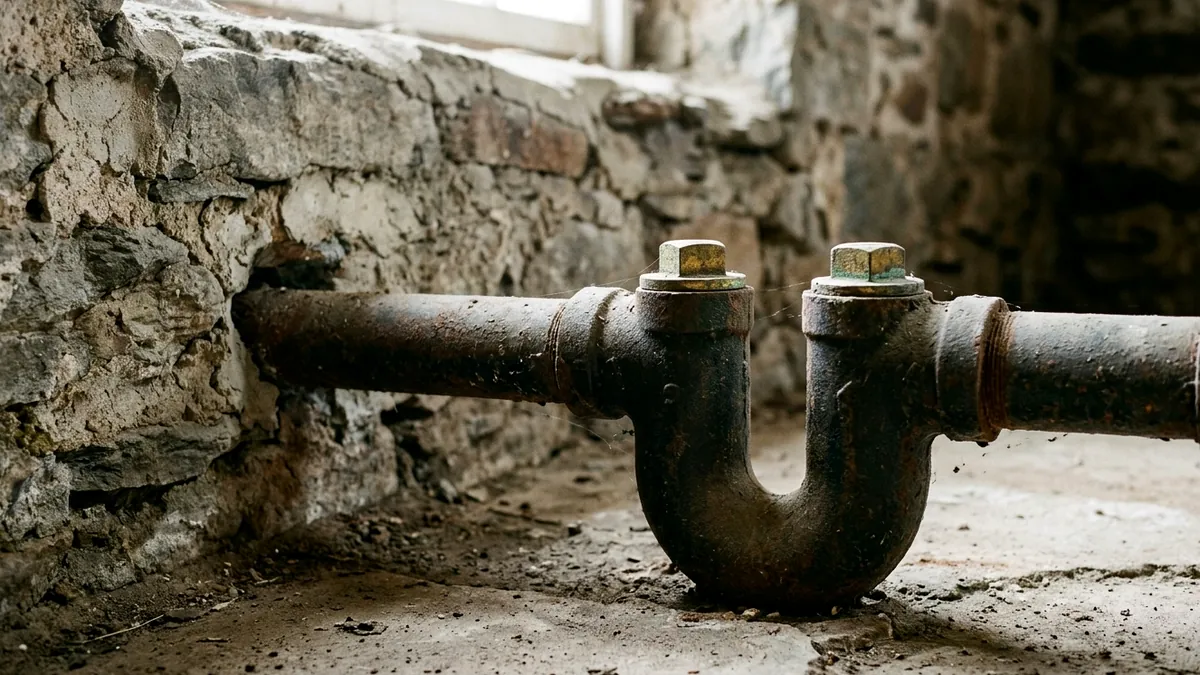
The old house trap near the foundation
Walk to the basement wall that faces the street and look at the main drain where it heads out. In many older Northeast houses you will find a house trap, a U-shaped fitting set in the line with one or two plugs on top. It was installed to hold a water seal against sewer gas from the street. Today's plumbing relies on traps at each fixture and a vent through the roof, so the house trap mostly serves as a place for paper and debris to catch.
House traps are a common clog point, and their plugs can be useful access points when they still open. Whether a house trap should be removed, replaced or left in place depends on how the house is vented and on local code, so it is a decision to make with a plumber, not a weekend project. Removing one without the right venting can let sewer gas into the house.
Interior and exterior cleanout options
The simplest upgrade is inside. A plumber cuts a new wye fitting with a cleanout plug into the building drain near the base of the stack, aimed toward the street. A seized plug can often be drilled and broken out so the cast-iron hub stays intact, then replaced with one that opens easily. If the drain is behind a finished wall, a small access panel keeps the cleanout reachable without cutting drywall during the next clog.
An exterior two-way cleanout goes on the house sewer just outside the foundation, with a riser to a cap at ground level. From that one spot, a cable can run toward the street or back toward the house, and the water and debris from the cleaning stay outside. It takes digging at the foundation, cutting the sewer and setting the fitting, so utilities have to be marked first through Call Before You Dig (811).
Signs it is time to add or fix a cleanout
If the last clog meant pulling a toilet, a cleanout should be on your list. The same goes for houses with large trees near the sewer line, where roots come back and the line needs regular cleaning, and for multi-family houses where a main line backup affects every unit. Homes in older parts of Hartford with combined sewers, where heavy rain can push water back toward basements, gain from both a cleanout and a backwater valve on the main line.
Selling or buying an older house is another good time. A sewer camera inspection is far easier and more complete from a proper cleanout, and a clear video of the line answers questions before closing. Once you have a cleanout, keep it accessible: do not pave, deck or plant over an exterior cap, and keep storage off an interior one.
- A recent clog required pulling a toilet
- Tree roots return to the sewer every year or two
- Several units share one main drain
- A camera inspection is planned for a sale or purchase
Typical costs and next steps
Hartford-area prices depend on what is there now and how much digging or cutting is needed. Typical ranges run about $165 to $345 to loosen or replace a seized cleanout plug, $395 to $865 for a new interior cleanout at the base of the stack, and $1,485 to $3,285 for an exterior two-way cleanout with a riser to grade. The final price is quoted on site before work starts.
If you are not sure whether your house has a usable cleanout, start by looking along the main drain from the base of the stack to the front foundation wall, and outside near the foundation for a capped pipe at ground level. Then call (860) 926-8723. We answer 24/7, and we can tell you whether the plug you found will open, whether a house trap is in the line, and where a new cleanout would give the best reach.
Key takeaways
- A cleanout gives a direct path into the sewer for cables and cameras
- Many older houses have plugs that are rusted shut or hidden
- House traps near the foundation are a frequent clog point
- Keep any cleanout clear, marked and easy to open