Know where the cold spots are
Hartford's triple-deckers and brick multi-family buildings were built long before walls were insulated the way they are now, and many were changed over the years. Kitchens and bathrooms got added onto rear porches, plumbing got run through outside walls, and back stairwells were left unheated. Those are the places pipes freeze. The supply lines under a kitchen sink on an exterior wall are the classic spot, along with any bathroom that sits over an enclosed porch.
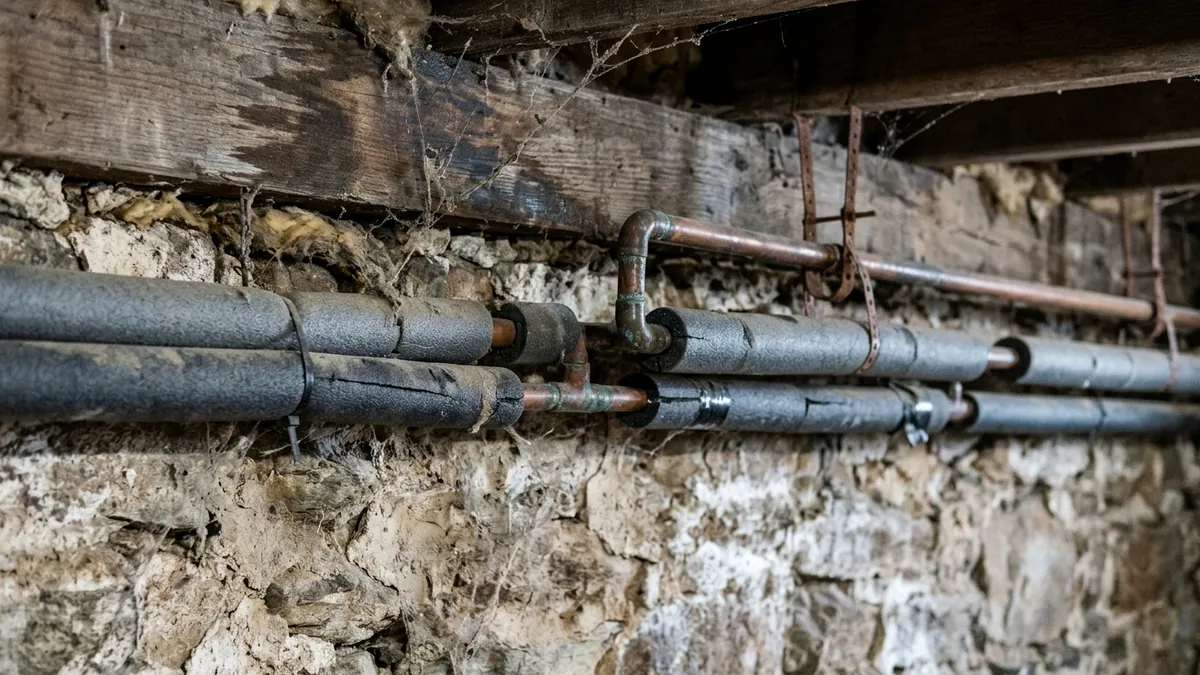
In the basement, the weak point is usually the rim joist, the band of framing that sits on top of the foundation wall. Cold air leaks in through gaps around the sill and old pipe and wire holes, and the pipe running closest to that wall freezes first. Outdoor faucets, pipes in crawl spaces under additions, and anything near a basement window with a broken pane or a dryer vent belong on the same list.
- Sink lines on exterior walls
- Bathrooms over porches or additions
- Basement pipes along the rim joist
- Crawl spaces and unheated rear stairwells
- Outdoor faucets and their supply pipes
Seal and insulate in the fall
The cheapest fix is stopping the cold air. Walk the basement on a windy day and feel along the top of the foundation wall for drafts. Gaps around the sill can be sealed with canned foam or caulk, and larger holes with rigid foam board cut to fit. Fix broken basement window panes and make sure the dryer vent flap closes. Sealing the air leak often keeps a pipe from freezing better than wrapping it does.
Then insulate the exposed pipes in cold areas with foam pipe sleeves sized to the pipe, taping the seams and covering the elbows. Insulation slows heat loss but does not add heat, so a pipe in a space that drops below freezing for days can still freeze. For those runs, a self-regulating heat cable made for pipes, plugged into a GFCI outlet and installed by the maker's directions, adds the warmth that insulation cannot.
Shut down and drain outdoor faucets
Every outdoor faucet should be dealt with before the first hard freeze. Disconnect the hose, since a hose left on traps water in the faucet. On an older standard sillcock, find the shut-off valve on the pipe inside the basement, close it, then open the outdoor faucet to drain the short section of pipe between them. Leave the outside faucet open for the winter so any water left inside has room to expand.
A frost-proof sillcock has a long body that reaches into the heated part of the house, with the actual valve seat inside, so it drains itself when shut, as long as the hose is off and the faucet slopes slightly down toward the outside. If an outdoor faucet has split before, or drips in winter, replacing it with a frost-proof model and adding an inside shut-off is a small job that can save a ceiling.
Keep heat on in every unit
Vacant apartments are where many winter bursts start. A unit between tenants, or a tenant away for the holidays, with the heat turned down to nothing can freeze its kitchen lines on the first cold night. Keep every unit's thermostat at 55 degrees or higher through the winter, and check that the heating system actually holds that temperature in the coldest room, not only near the thermostat.
On very cold nights, open sink cabinet doors on exterior walls so room air reaches the pipes, and let a thin, steady stream run from the faucets most at risk. Moving water is much harder to freeze. If one thermostat or one boiler zone serves more than one floor, the rooms far from it can run colder than the setting suggests, so check them with a simple thermometer during a cold snap.
If a pipe freezes
A faucet that gives a trickle or nothing on a cold morning, while others work, usually means a frozen section. Leave that faucet open. Find the cold spot, often on an exterior wall or near the rim joist, and warm it gently with a hair dryer, a space heater kept well away from anything that can burn, or warm towels. Work from the faucet end back toward the frozen spot so melting water can flow out.
Never use a torch, a propane heater or any open flame on a frozen pipe. It can start a fire inside the wall and can heat a pipe unevenly enough to split it. If you cannot find or reach the frozen section, or the pipe has already cracked, close the main shut-off and call (860) 926-8723. We answer 24/7 all winter. Typical Hartford-area costs to thaw and check a frozen line run about $195 to $465, quoted on site before work starts.
Plan for the coldest weeks
January and February are when most frozen pipes happen, so set a routine before then. Know where the main shut-off is and make sure it turns. Tag the inside valves for outdoor faucets. Give each tenant a short note on keeping the heat at 55 degrees or more, opening cabinet doors on bitter nights, and what to do if a faucet stops running. A two-minute walk through the basement after a cold night catches trouble early.
If a pipe in the same spot freezes every winter, the lasting fix is changing the plumbing, not hoping for a mild year. Rerouting a supply line from an outside wall to an interior one, moving a pipe out of an unheated porch floor, or insulating and enclosing a crawl space so the pipes sit on the warm side all end the problem. A plumber can look at the layout and say which change fits the building.
Key takeaways
- Seal drafts at the rim joist before insulating
- Shut and drain outdoor faucets before the first hard freeze
- Keep every unit at 55 degrees or warmer
- Never thaw a pipe with an open flame