Why heavy rain reaches your basement
Many older Hartford streets are served by combined sewers, pipes built long ago to carry storm water from streets and roofs together with sewage from homes. In ordinary weather the system handles both. In a heavy, fast rain the combined pipes fill up, and the water has to go somewhere. Your house sewer connects to that street pipe, and the lowest opening in your house is usually a basement floor drain.
When the street sewer is running full, the water level in it can rise above your basement floor. Water then flows backward up your house sewer and out of the floor drain, a basement toilet or a laundry sink. That is why the water that comes up is gray or brown and smells of sewage. The Metropolitan District's Clean Water Project is separating and upgrading lines, but older connections remain in many neighborhoods.
Other causes worth ruling out
Not every backup comes from the street. A house sewer partly blocked by tree roots, grease or a collapsed section of old clay or cast-iron pipe will back up whenever enough water flows, rain or not. If the drain backs up on dry days, when the washer drains, or only in one unit of a multi-family house, the problem is more likely in your own line. A sewer camera inspection shows which it is.
Rain itself can also be piped into your sewer. In some older homes, roof downspouts run into the ground and tie into the house sewer, and some sump pumps discharge into a floor drain or laundry sink. Both add storm water to the very pipe that is trying to drain your house during a storm. Redirecting downspouts and sump discharge to the yard, away from the foundation, takes load off the line.
- Backups on dry days point to your own line
- Backups only in storms point to the street sewer
- Downspouts tied into the sewer add storm water
- Sump discharge belongs outdoors, not in a drain
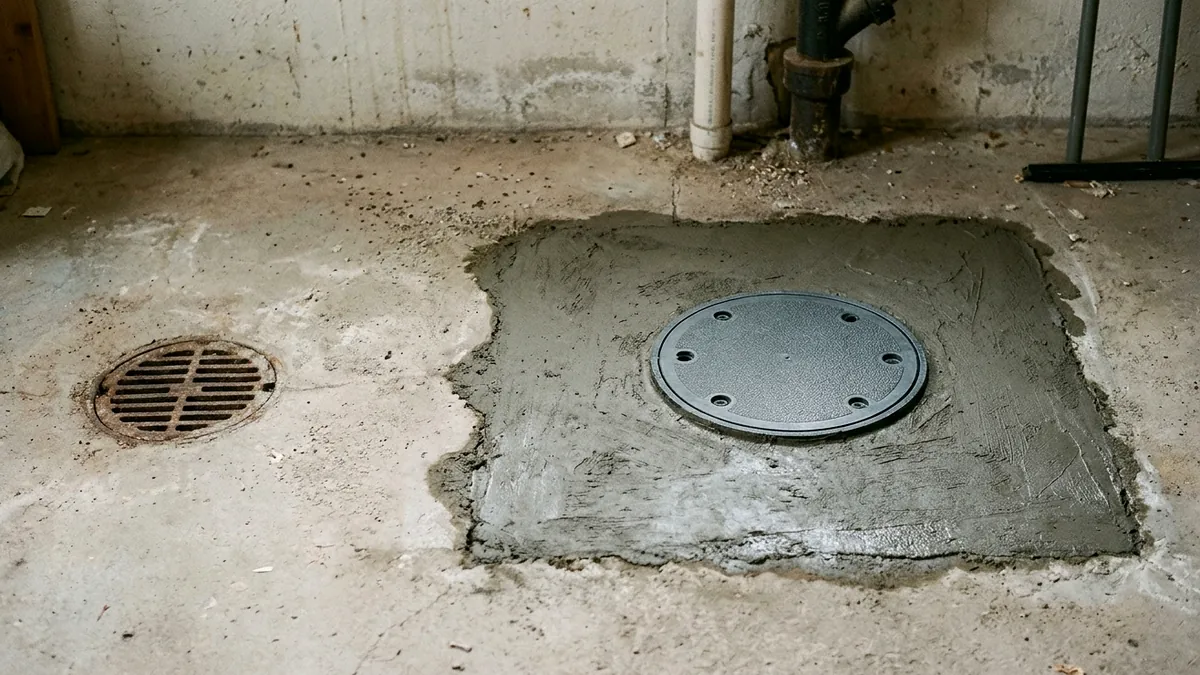
What a backwater valve does
A backwater valve is a one-way valve installed in your main building drain. Under normal flow, water from the house pushes a hinged flap open and passes out to the street. When the street sewer surcharges and water starts flowing back toward the house, the flap swings shut and seals the pipe, so the sewer water stays outside your foundation. When the level in the street drops, the flap opens again on its own.
The valve sits in a box set into the basement floor, or sometimes outside, with a cover you can remove to see and clean it. Installing one in an existing house usually means cutting the concrete floor, digging down to the main drain, setting the valve in line and patching the floor. A permit from the town building department is generally required. Placement matters, since it has to protect the fixtures that sit below street sewer level.
Living with a backwater valve
One rule matters most. While the flap is closed during a storm, water from inside the house cannot leave either. If you run the washer, take showers or flush toilets during a heavy rain, that water has nowhere to go and can come up through the lowest drain on your side of the valve. During a big storm, hold off on laundry and long showers until the rain eases and the street sewer drains down.
The valve also needs a little care. Open the cover in the spring and again in the fall, check that the flap moves freely, and clear any debris, grease or paper that could hold it open or shut. A valve stuck open does nothing, and one stuck shut backs up the house. Some owners also add a floor drain plug with a floating ball as an extra layer on a single drain.
- Avoid heavy water use during big storms
- Check the flap each spring and fall
- Clear debris from the valve box
- Keep the access cover clear and easy to reach
When sewage has already come up
Treat backed-up water as sewage. Keep children and pets out of the basement. Do not walk through water that is touching outlets, appliances or a furnace, and if the electrical panel is in the wet area, leave the power alone and call your electric utility from outside. Wear rubber boots and gloves for cleanup, and throw out porous items that soaked in sewer water, such as carpet, cardboard and upholstered furniture.
Hard floors and walls can be washed with detergent and then disinfected, and the space needs to dry quickly with fans and a dehumidifier. Once the water drains away, have the line checked so you know whether the street sewer or your own pipe caused it. For a fast cleanup and a look at the cause, call (860) 926-8723. We answer 24/7, and storm nights are when many basements need help.
Typical costs
Hartford-area prices vary with how deep the house drain sits and how much concrete has to come out. Typical ranges run about $1,485 to $3,860 for an indoor backwater valve installed in an existing basement floor, $345 to $690 for a sewer backup cleanout, and $265 to $495 for a sewer camera inspection with a recorded video. The final price is quoted on site before work starts, once the plumber has seen the layout.
If the camera finds roots or a broken section, it makes sense to fix the line while the floor is already open. A backwater valve protects against the street, but it cannot help if your own sewer is failing. Fixing both, in the right order, is what keeps a basement dry through the next storm season. Ask for the camera video so you can see the problem yourself.
Key takeaways
- Combined sewers can push storm water back into basements
- Dry-day backups point to a problem in your own line
- A backwater valve closes when the street sewer runs backward
- Limit water use inside while the valve is closed