Start by asking where the pressure is low
The most useful question is whether the low pressure is everywhere or in one place. If only one faucet or one shower is weak, the cause is almost always at that fixture or the pipe close to it. If every faucet in the house dropped at once, the cause is upstream, at the main valve, the pressure regulator, the service line or the water supply itself.
Next, note whether it is hot, cold or both. Low pressure only on the hot side points to the water heater: a partly closed valve on the heater, sediment, or a failing dip tube or outlet fitting. Low pressure only upstairs in a two- or three-family house, with good pressure on the first floor, often points to narrowed galvanized pipe in the risers. Writing down these details helps whoever comes to look.
- One fixture or the whole house?
- Hot side, cold side or both?
- Sudden or gradual?
- Upper floors worse than the first?
Easy fixes at the fixture
Faucet aerators, the small screens at the tip of the spout, catch grit and mineral flakes. Unscrew the aerator, rinse it, soak it in white vinegar if it has scale, and put it back. Showerheads get the same treatment, and many have a flow restrictor inside that can clog. This is often all a single weak faucet needs, especially after a repair that stirred up sediment in the pipes.
Then check the small shut-off valves under the sink or behind the toilet. They sometimes get bumped or partly closed during cleaning or repairs. Open them fully by turning counterclockwise. A single-handle shower or faucet that is weak on both hot and cold may have a clogged or worn cartridge, which can be cleaned or replaced, and a pressure-balancing shower valve can restrict flow when it starts to fail.
Whole-house causes
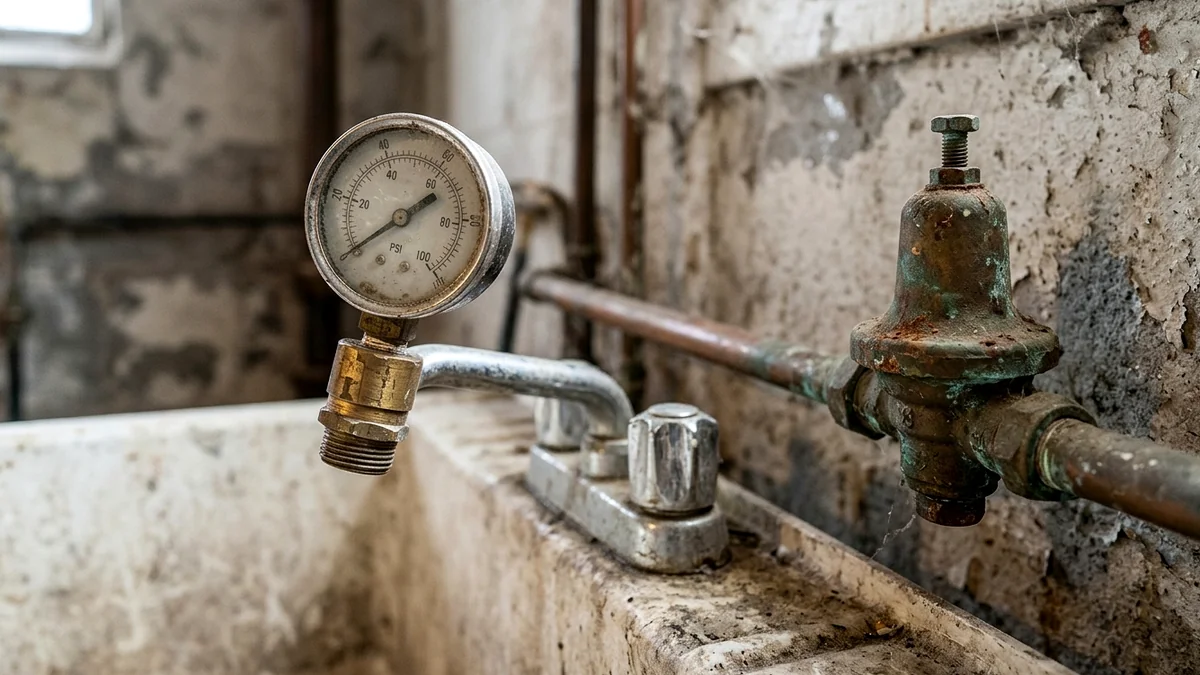
If the whole house dropped, start in the basement. Make sure the main shut-off is fully open. An old gate valve that was turned partway during a repair, or one whose wedge has dropped inside the body, can choke the flow even when the handle seems open. Many homes also have a pressure-reducing valve, a bell-shaped brass fitting just after the main shut-off, that can fail and cut pressure.
Before assuming the problem is in your house, ask a neighbor whether their pressure changed. Water main work, a break in the street, or a hydrant being flushed can lower pressure for a whole block for a while. For Hartford and the MDC member towns, the Metropolitan District posts work and service notices. On a private well, low pressure usually points to the pressure switch, the pressure tank or the pump instead.
Aging pipe and hidden leaks
Pressure that has faded slowly over years, rather than dropping suddenly, often means galvanized steel pipe that has narrowed with rust and scale on the inside. This is common in Hartford houses built before 1940, and it gets worse on the top floor because the water has farther to climb through narrowed risers. Cleaning aerators helps for a week and then the problem returns as more rust breaks loose.
A sudden drop with no other explanation can also be a leak. Check the water meter with everything in the house turned off. If the dial or the small leak indicator keeps moving, water is going somewhere: a running toilet, a dripping outdoor faucet, or a break in the service line or under a slab. Wet spots in the yard along the line from the street, or a hissing sound near the main, are worth reporting.
- Turn off every fixture
- Watch the meter dial or leak indicator
- Movement means a leak somewhere
- Check toilets and outdoor faucets first
When to call a plumber
Call when the fixture fixes do not help, when the whole house is affected and the main valve is fully open, when the meter shows a leak you cannot find, or when the pressure has faded over time in an older home. Also call if the pressure is too high, above about 80 psi, since that strains fixtures, the water heater and appliance hoses. A plumber can test the pressure with a gauge on an outdoor faucet or laundry tap.
Typical Hartford-area costs run about $215 to $465 to diagnose and fix a whole-house pressure problem such as a failed regulator or main valve, and more when the cause is old pipe or a service line leak. The final price is quoted on site before work starts. Call (860) 926-8723 and tell us what you found in the checks above. We answer 24/7.
Key takeaways
- One weak fixture usually means an aerator, cartridge or stop valve
- Whole-house drops start at the main valve and regulator
- Slow loss over years in an older home suggests galvanized pipe
- A moving meter with everything off means a leak