What these pipes are and where they hide
Galvanized pipe is steel coated with zinc, joined with threaded fittings, and it carried water in many houses built before the 1960s. In an older two- or three-family house you will often find it in the basement and running up through the walls to each floor, sometimes with newer copper or plastic patched in where earlier repairs were made. It is gray, it has threaded joints, and a magnet sticks to it.
Cast iron is the heavy black or rust-brown pipe that carries waste and vent water. In Hartford's triple-deckers, a cast-iron stack usually runs from the basement to the roof, with each floor's kitchen and bathroom draining into it. Older joints were packed with oakum and sealed with poured lead, and the horizontal main runs across the basement to the front wall, where it leaves for the street sewer.
Warning signs in galvanized supply pipe
Galvanized pipe corrodes from the inside. Rust and mineral scale build up on the inner wall year after year until the opening is a fraction of its original size. The first sign is usually weak flow, often worst on the top floor and on the hot side, because hot water speeds corrosion. A faucet that fills a pot slowly, or a shower that drops off when someone downstairs runs water, points to narrowed pipe.
Brown or yellow water after the taps sit overnight, or after the water has been shut off for a repair, is loosened rust. Leaks tend to start at threaded joints, where the pipe wall is thinnest, and as small pinholes along the run. Another weak spot is anywhere galvanized meets copper without a proper dielectric fitting, because the two metals corrode each other at the joint.
- Low flow, worst upstairs and on the hot side
- Brown water after the pipes sit
- Rust or crust at threaded joints
- Pinhole leaks along the run
- Corrosion where steel meets copper
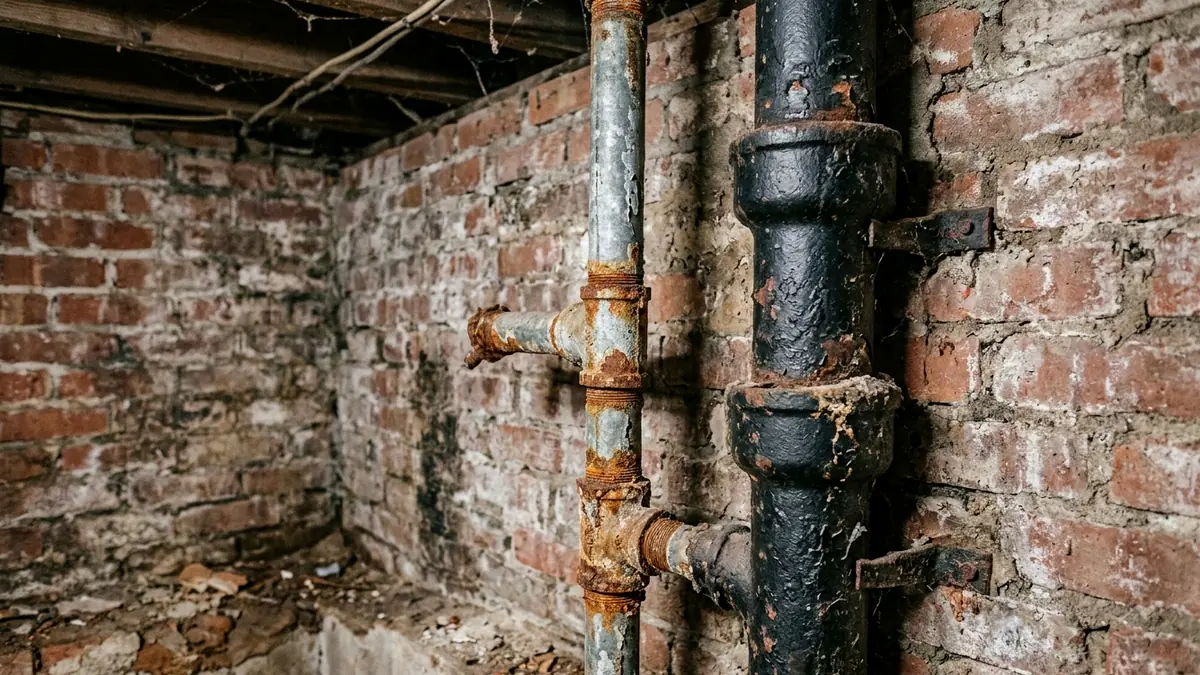
Warning signs in cast-iron drains
Cast iron also wears from the inside, and the bottom of a horizontal pipe goes first because that is where the water runs. Over decades it can thin and crack lengthwise, a problem plumbers call channel rot. From the outside the pipe may look sound while the bottom is nearly gone. Look for rust-colored stains or crusty buildup on the pipe, especially at joints, and damp spots on the floor under the main basement run.
A sewer smell in the basement or near a wall with a stack, slow drains on several fixtures, and drains that gurgle when a toilet upstairs flushes all suggest scale buildup or a crack. Vertical cracks in a stack, flaking layers you can pick off with a fingernail, and water marks on ceilings below a stack are signs that a section is near the end. A camera inspection shows the inside without opening walls.
- Rust stains or crust at joints
- Damp floor under the basement drain run
- Sewer smell near the stack
- Gurgling or slow drains on several fixtures
- Flaking or cracked pipe wall
Repair a section or replace it all
Not every old pipe needs to go at once. A cast-iron stack with one cracked section can often be repaired by cutting out the bad piece and fitting in PVC with banded couplings, as long as the rest of the pipe looks sound on camera. Galvanized supply lines that leak at one joint can be repaired the same way with transition fittings. The real question is how much of the system shows the same wear.
When flow is low on every floor, leaks keep showing up in new places, or the camera shows thin pipe in several runs, replacing the system is usually cheaper over time than paying for repair after repair. Supply repipes in older homes are commonly done in PEX or copper, run through existing chases where possible, and many owners do it one unit at a time. Cast-iron drains are usually replaced with PVC.
Questions to settle before you start
Ask whether the work will need a permit and inspection, how the plumber plans to reach pipe inside plaster walls, and who handles patching. Older Hartford homes often have plaster and lath, and good planning keeps openings small and in closets or behind cabinets. In occupied multi-family buildings, ask how long each unit will be without water or drains, since most of this work can be staged floor by floor around tenants.
If the house still has a lead service line from the street, or the galvanized pipe was installed downstream of one, mention it. Galvanized pipe that sat downstream of lead can collect lead in its inner scale, so replacing both together makes sense. Also check whether the main shut-off is an old gate valve, because a repipe is the right time to put in a new ball valve that closes properly.
Typical costs in the Hartford area
Prices depend on pipe size, access and how much wall has to be opened. Typical Hartford-area ranges run about $1,185 to $3,460 to replace a section of cast-iron stack or basement drain, and $3,940 to $8,670 to repipe one apartment's water supply from galvanized to PEX or copper. A full building runs more, depending on the number of units and floors. The final price is quoted on site before work starts.
Starting with a camera inspection of the drains and a look at the supply pipe at several points gives you a clear picture before you commit. That way you can choose between a targeted fix now and a planned replacement later, instead of waiting for a leak to choose for you. Most owners find it easier to schedule the work in a mild season, when shutting down water or drains for a day is less disruptive.
Key takeaways
- Galvanized pipe narrows from the inside, so low flow comes first
- Cast iron rots along the bottom of horizontal runs
- A camera inspection shows drain condition without opening walls
- Replace galvanized that sits downstream of a lead line at the same time