Why the hot water takes so long
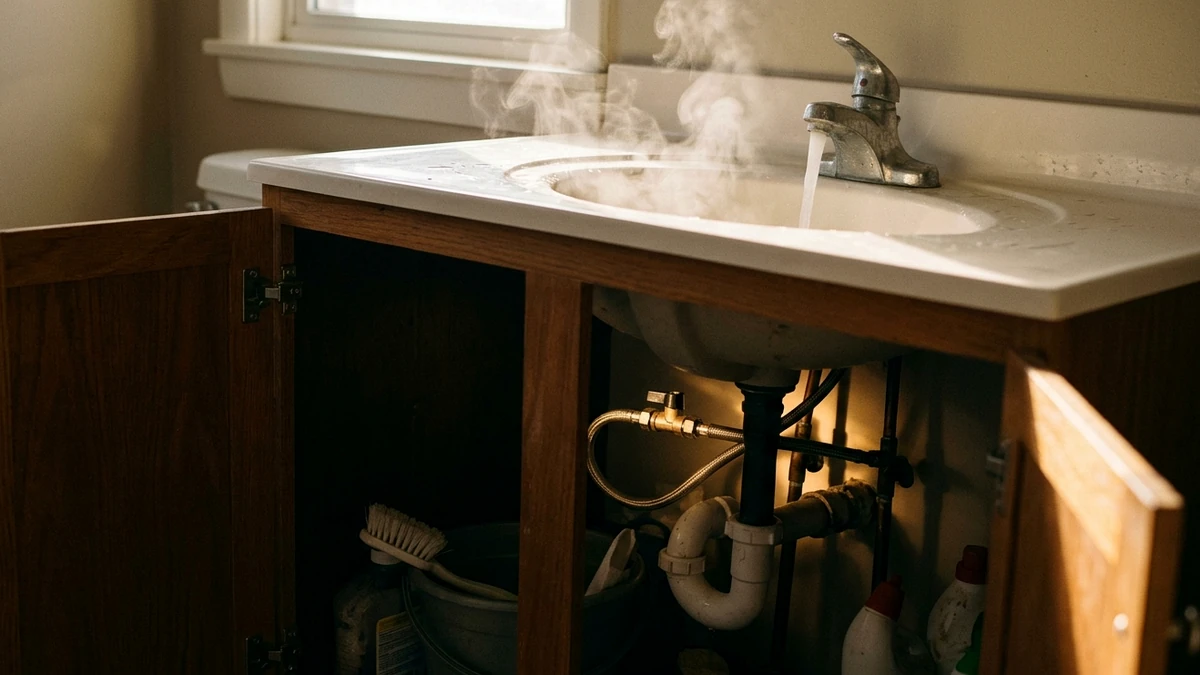
When you open a hot tap, the first water out is whatever sat in the pipe since the last use. That water left the heater hot and cooled to room temperature in the line, so you have to run it all out before fresh hot water arrives. The wait depends on how long the pipe is, how wide it is, and how fast the faucet flows. A long 3/4-inch line to a low-flow showerhead can take a minute or more.
Older houses often make this worse. In a Hartford-area two- or three-family house, each unit's heater usually sits in the basement and its hot riser climbs two or three floors to the kitchen and bath. Large single-family houses may have the primary bath at the opposite end from the heater. Low-flow fixtures, which save water during use, push water through the line more slowly, so the wait grows even though less water is wasted per minute.
Rule out a water heater problem first
A long wait is normal plumbing physics, but a short supply of hot water is not. If the water gets warm quickly but never truly hot, or runs out after a short shower, the heater may have a failed element, a broken dip tube, a sediment-filled tank or a thermostat set too low. Those are repairs, and a recirculation pump will not fix them. Check whether every hot tap in the house behaves the same way.
Also check whether the delay started recently. A new tankless water heater often adds a few seconds, because it needs a moment to sense flow and fire before it delivers heat. A plugged aerator or a failing mixing valve can slow flow at one fixture so much that the wait seems to double. If only one tap is slow, the cause is usually at that fixture, not in the whole system.
- Hot arrives slowly but stays hot: a distance problem
- Warm but never hot: check the heater and its settings
- Runs out quickly: possible element, dip tube or sediment issue
- One tap only: look at that fixture's aerator or valve
Option one: a dedicated return line
The classic fix is a loop. A third pipe runs from the end of the hot line, at or near the farthest fixture, back to the bottom of the water heater. A small pump at the heater moves water around the loop, so hot water is always waiting near every fixture it passes. A check valve keeps the flow going the right way. Because the cold pipe is not involved, cold taps stay cold.
Adding a return line is easiest when walls are open during a remodel, or when the hot lines are reachable from an unfinished basement. Some older houses already have one from an old gravity loop that was capped years ago, and putting it back in service can be a small job. Insulating both the hot supply and the return line holds heat in the loop and lets the pump run less often.
Option two: an under-sink crossover valve
When a new pipe is not practical, a crossover system borrows the cold line. A thermostatic valve goes under the sink farthest from the heater and connects the hot and cold supply stops. A pump, either at the heater or under that sink, pushes the cooled water out of the hot pipe, through the valve and back to the heater through the cold pipe. When warm water reaches the valve, it closes and the pump stops moving water.
This is the least invasive retrofit, but it has a catch. Because the cold pipe carries the returning water, the cold tap at that sink can run lukewarm for a few seconds before it turns cold. Fixtures on a separate branch of the hot piping may not benefit much. And a pump mounted under the sink needs an electrical outlet in the cabinet. For many houses, those trade-offs are worth a hot shower in seconds.
Controls that save energy
A recirculation pump left running all day and night keeps hot water at every tap, but it also loses heat from the pipes all night when nobody uses it. Controls fix that. A simple timer runs the pump during your morning and evening routines. A temperature sensor turns the pump off once the loop is warm. On-demand controls run the pump only when someone presses a button or a motion sensor sees someone walk into the bathroom or kitchen.
On-demand and timed controls cut most of the energy cost of a continuous system while keeping the convenience. Tankless heaters in particular should usually be paired with on-demand control, since constant circulation makes them fire over and over. Some tankless models have a pump and recirculation mode built in, and the manufacturer's instructions set what piping they need. Check current Energize CT offers when you plan any water heating upgrade.
- Timer: runs on a set daily schedule
- Temperature sensor: stops once the loop is warm
- On-demand button or motion sensor: runs only when needed
- Continuous: always ready, but the highest heat loss
Costs and what to ask before you choose
Typical Hartford-area costs run about $435 to $895 for an under-sink crossover valve with an on-demand pump, $585 to $1,165 to add a pump, check valve and timer to an existing return line, and $1,845 to $4,385 for a new dedicated return line with a pump and controls. Older galvanized pipe can shed rust when circulation starts, so ask whether your piping is a good candidate. The final price is quoted on site before work starts.
Before you decide, time the wait at your worst fixture, note which taps matter most to you, and find out whether your house has an old return pipe. Then call (860) 926-8723. We answer 24/7. A plumber can trace the hot lines from the heater, tell you which option fits your house, and set the controls around the hours your household actually uses hot water.
Key takeaways
- The wait is cooled water in the pipe, not a lack of hot water
- Rule out heater problems before adding a pump
- Return lines keep cold taps cold; crossover valves avoid new pipe
- Timers and on-demand controls cut the energy cost of circulation